Why 3-2 Count?
I chose the title 3-2 Count for this blog because I believe it to be the most interesting count in all of baseball. Let me explain why.
A 3-2 count sits on the razor’s edge for drastically different outcomes of the at-bat. A pitch thrown for a ball puts the hitter on first base, and a called strike sends him back to the dugout. Barring a foul ball, the next pitch is guaranteed to lead to action.
Fairly straightforward. But this is where things get interesting.
While the underlying data isn't publicly available, you’ll have to take my word for this next stat. When you compare across every count in baseball the expected run value of a swing versus that of a take (no swing), no count produces a larger gap than 3-2—and it’s not even close. In 3-2 counts it’s far more valuable in terms of expected runs, on average, for a hitter to take than to swing the bat.
If hitters behaved like economists, the 3-2 count would produce some of the lowest chase rates of any count. But that’s not what we see:
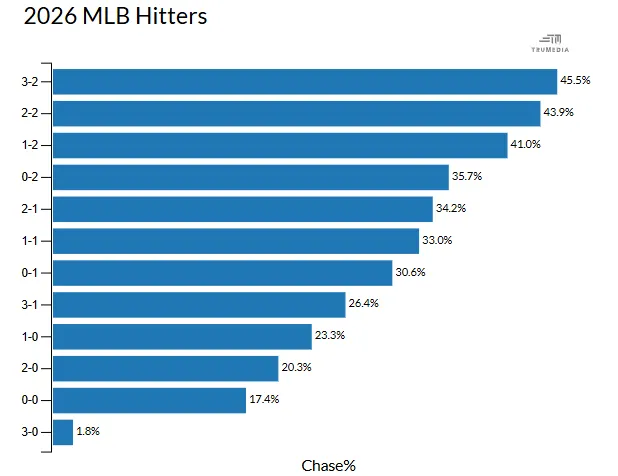
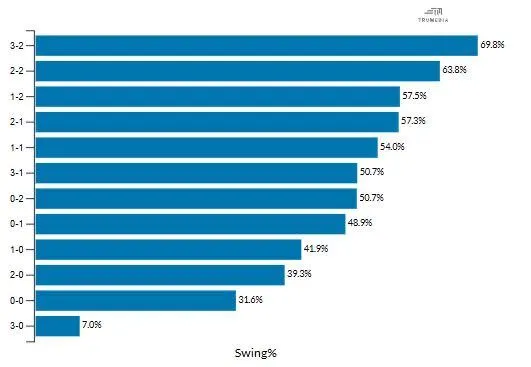
Data source: TruMedia (MLB regular season data)
In the situation where the expected run value of not swinging the bat is greatest, we see the highest swing rates and chase rates of any count!
Why is this the case?
The answer, I think, has less to do with baseball skill and more to do with human psychology.
As a hitter, a 3-2 count is stressful. When you dig in, you can feel your heart rate increase and your adrenaline rise. You pick up on subtle non-verbal signals that the pitcher is about to really bear down. You sense everyone in the ballpark, including yourself, anticipating the finality of the at-bat. Action feels necessary.
From my own experience, there was another less obvious but pervasive feeling that showed up in these moments: the desire to avoid embarrassment. A strike-out looking felt far more exposed in a full count than it did earlier in the at-bat. The consequences seemed magnified, and the impulse to avoid that feeling was real. Judging by the data, I am not the only hitter who felt that way.
My takeaway of what the 3-2 count reveals is that when perceived pressure is highest, we often become less concerned with making the best decision and more concerned with avoiding the wrong one.
The title of this blog, 3-2 Count, serves as a reminder that psychological pressures can easily pull us away from more rational and prosperous choices. Whether it’s in baseball, business, or everyday life, the challenge is not eliminating emotions, uncertainty, or fear—those things are inevitable because we're human. It is learning to think and choose clearly in spite of them.
A big challenge, for sure, but one I believe is worth taking on.